

Installation simulation
See the finished system, watch it go up stage by stage, or follow the energy from the panels to the main panel.
Completed installation
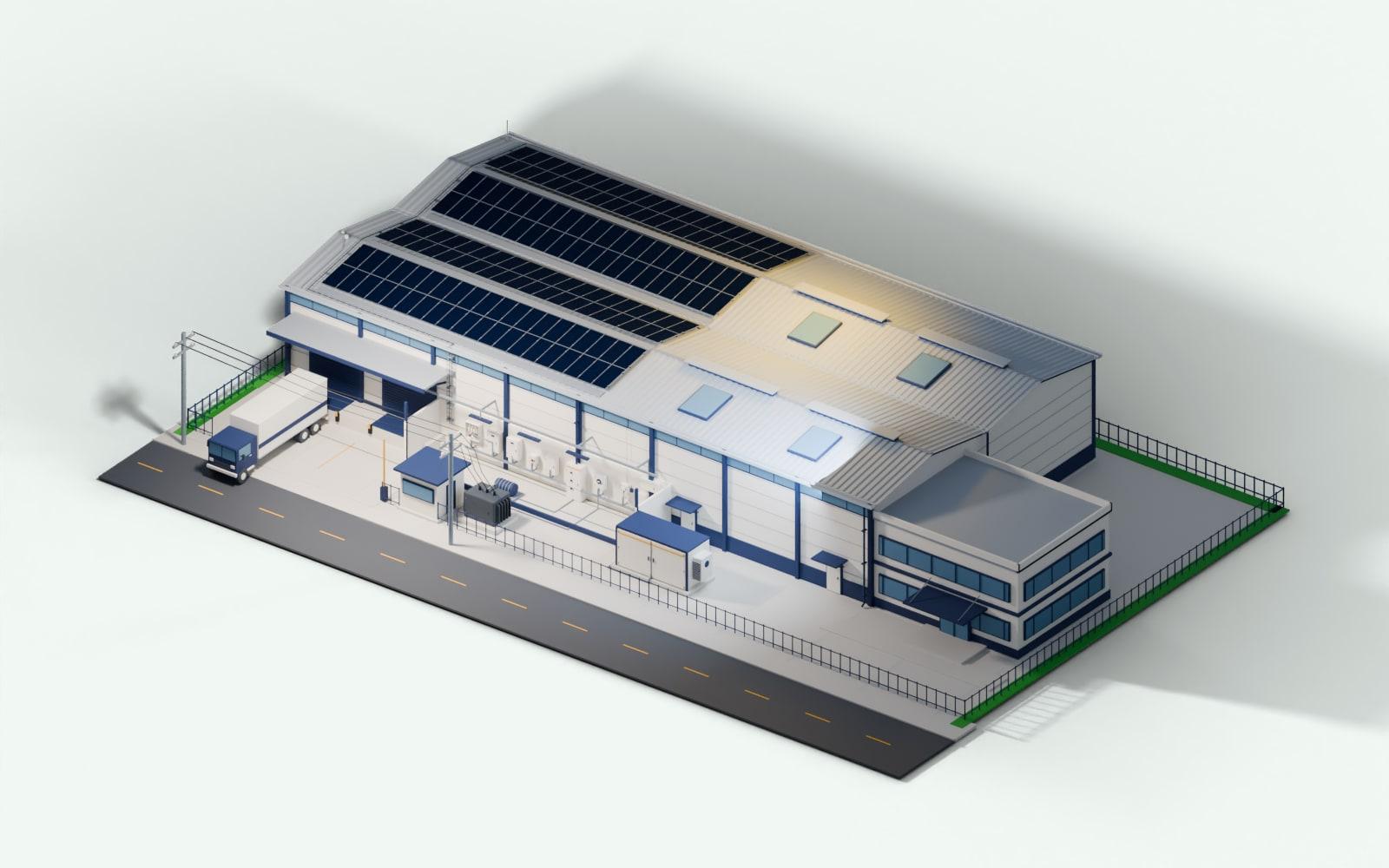
Drag to orbit · point at a part
- L-feet and seals: Sealed feet connect the rails to the roof structure.
- Rails and splices: Rails spread module loads between the roof attachments.
- Optimizers: An optimizer under each module tracks that panel's best output and can bring the array down to a safe voltage.
- PV array: 160 portrait modules form two dense rows per roof plane, with 20 mm module gaps, 30 mm row gaps and a 600 mm walkway after each pair.
- Module clamps: Mid and end clamps hold the module frames against the rails.
- Inverter rack: A galvanized roof inverter rack: a base channel on the floor and two posts per inverter, which locks onto them.
- Inverter canopy: A lean-to metal roof keeps direct sun off the inverters and boards, so they run cooler. Flush lights underneath light the area at night.
- Inverters: Two string inverters on a galvanized roof inverter rack, shaded by the canopy, take the panel strings straight into their DC inputs and convert solar DC into building AC. A red DC switch at each end isolates them for service.
- Solar panel board: Wall-mounted, with a breaker for each inverter, a main breaker for the combined output and a power meter on the door. It feeds the main panel.
- Data logger: Collects operating data from the inverters and the battery and reports the system's status online.
- DC string cables: Paired cables and locking connectors carry current from each module string.
- Cable trays: Perforated metal trays carry the cables down the wall from the roof, under both inverters straight to the solar panel board and on to the main panel and the BESS panel board.
- Earthing and lightning: Bonding conductors and an electrode provide an earth path while a finial intercepts lightning.
- BESS panel board: Wall-mounted, with the breakers between the battery cabinets and the main panel. Charging and discharging both pass through it.
- Battery Energy Storage System (BESS): Outdoor battery cabinets store solar energy for the evening and for outages. Each one holds its battery packs, power conversion, cooling and fire detection behind one sealed door.